Powder Coating / Shot Blasting Plants
Back to Industries

Powder Coating / Shot Blasting Plants

Efficient recovery systems for powder coating and dust extraction for shot blasting booths.

Industry Overview

Overspray recovery and surface preparation dust control are key to economic and safe finishing operations.

Key Challenges

High efficiency powder recovery
Handling fine metallic dust
Maintaining booth visibility
Filter cleaning effectiveness

Market Landscape & Opportunities

Powder coating has revolutionized industrial finishing, offering superior durability, environmental compliance (zero VOC emissions), and cost-effectiveness compared to liquid paint. Gujarat has 500+ powder coating job shops plus in-house coating lines at furniture manufacturers, appliance makers, automotive component suppliers, and architectural aluminum fabricators. The powder coating process involves surface preparation (cleaning, phosphating/chromatizing for corrosion protection), electrostatic powder application (charged powder particles attracted to grounded part adhering via electrostatic force), and curing (baking at 160-220°C for 10-30 minutes causing powder to melt, flow, and crosslink forming durable finish). Air handling is critical throughout: Booths with downdraft or crossdraft airflow capturing overspray powder (40-50% of sprayed powder doesn't adhere, must be recovered for reuse), powder recovery via cyclone separators and cartridge filters achieving 99%+ collection, curing oven circulation fans distributing heat uniformly (±3-5°C temperature uniformity preventing defects), and oven exhaust managing volatile products released during powder cure.

Technical Requirements

Spray booth airflow: 80-150 FPM face velocity capturing overspray preventing booth escape. Typical booth 8×8×10 ft = 100-200 CFM per sq.ft opening × 64 sq.ft = 6,400-12,800 CFM. Larger booths 20,000-40,000 CFM. Powder recovery: Primary cyclone removing 85-95% of powder (particle size 20-80 micron, density 1.2-1.6 g/cm³ allowing good cyclone performance), cartridge filter polishing to <1 mg/m³ for discharge compliance and powder conservation. Recovery rate target >98% (lost powder = wasted material + disposal cost). Explosion protection: Powder organic polymer dust is combustible—Kst 100-200 bar-m/sec (St-1 explosive class). Require ATEX Zone 22 equipment, explosion venting, proper grounding (powder charging creates static—must dissipate preventing spark), inlet spark detection if recirculating for energy savings. Oven airflow: Circulation 8-15 air changes per minute (ACM) creating turbulent mixing. 10×5×8 ft oven = 400 cu.ft × 10 ACM = 4,000 CFM circulation. Temperature uniformity ±3°C across product.

Our Industry Solutions

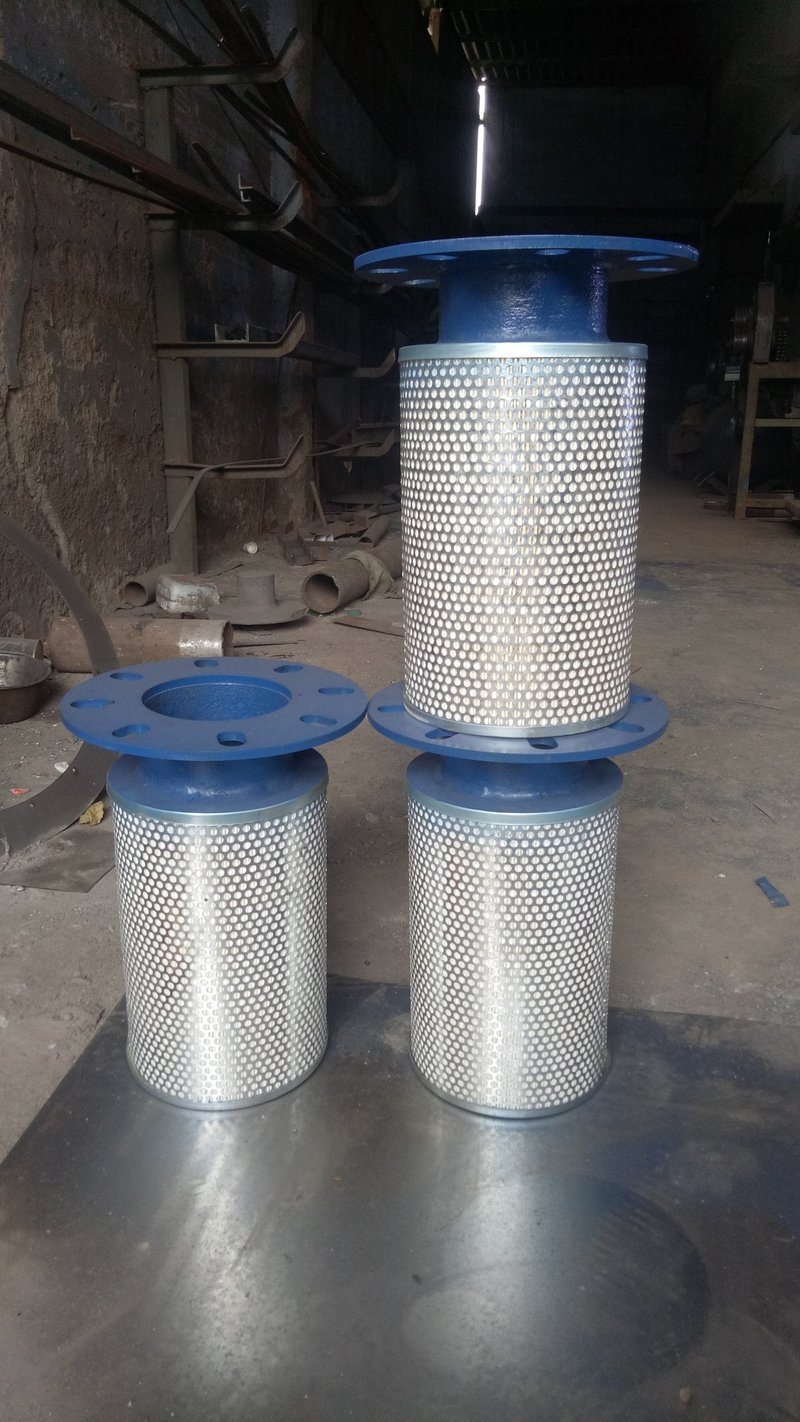
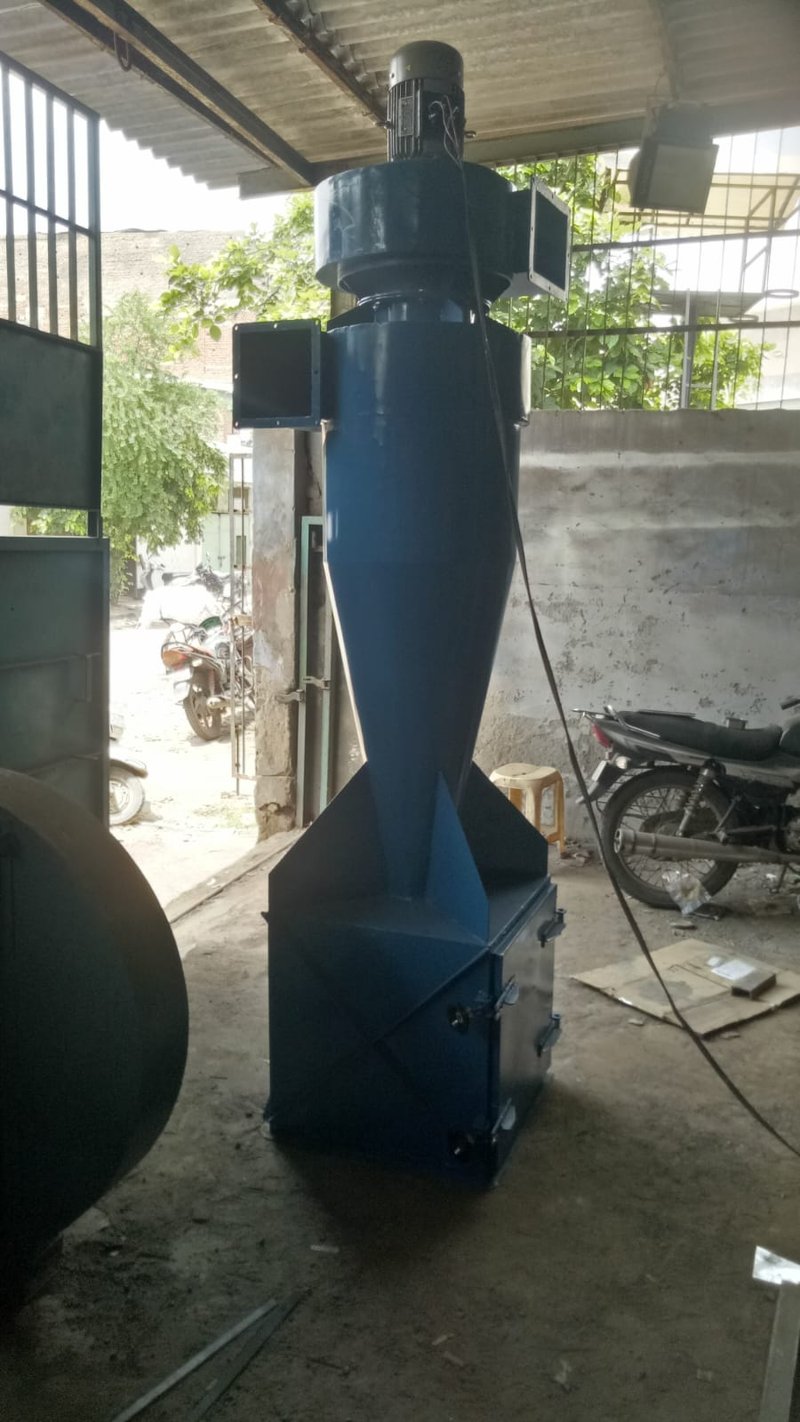
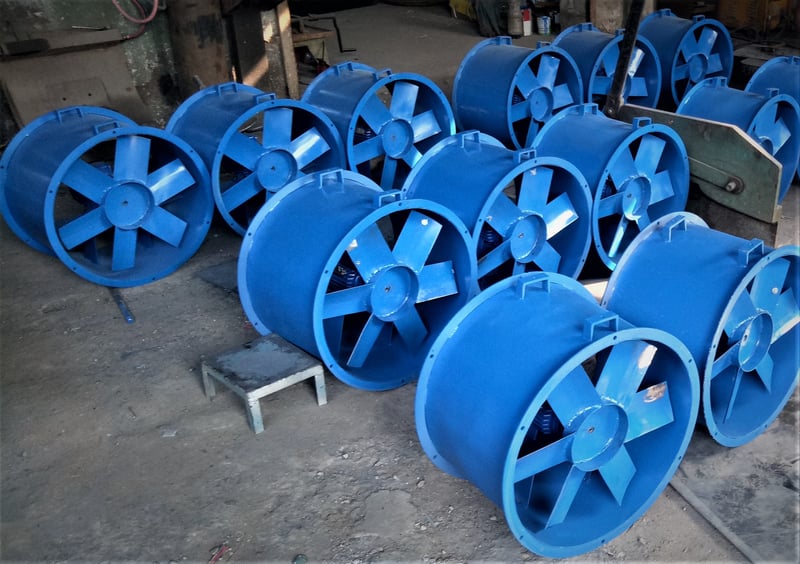
We supply complete powder coating air systems to 40+ coating shops. Our spray booth packages feature cyclone + cartridge filter combinations achieving 99.2% powder recovery (customer reduced powder waste from ₹8 lakh/year to ₹60,000/year—payback 14 months), explosion-protected fans and filter housings meeting ATEX requirements, and automated pulse-jet cleaning maintaining consistent −50 to −80 mmWC booth pressure. For an appliance manufacturer with 6-booth coating line, we designed centralized powder recovery serving all booths with color-change capability—automated dump valves isolating each booth's recovered powder preventing cross-contamination between colors. Our curing oven circulation fans use high-temp construction (220°C continuous rating) with stainless impellers resisting corrosive cure byproducts, precision VFD control ramping airflow during cure cycle (high flow during ramp-up for fast heating, reduced flow during soak preventing surface defects from excessive turbulence), and hot-gas bypass for precise temperature control.

Industry-Specific FAQs

Frequently Asked Questions

Common Questions About Powder Coating / Shot Blasting Plants

Find answers to the most common questions asked by our clients.

Material cost: Powder costs ₹150-400/kg (standard colors) to ₹600-1,500/kg (specialty metallics, textures). Transfer efficiency (powder adhering to part vs overspray) 50-70% for manual guns, 70-85% for automatic. Coating 1,000 sq.m/day at 80 µm thickness requires: 1,000 m² × 80 µm × 1.4 g/cm³ × (1/0.65 efficiency) = 175 kg powder/day. At ₹250/kg = ₹43,750/day. Overspray quantity: 35% overspray × 175 kg = 61 kg/day overspray. Without recovery: 61 kg/day wasted = ₹15,250/day × 300 days = ₹45.75 lakh/year! Plus disposal cost ₹20-40/kg = ₹3.6-7.3 lakh/year. With 98% recovery: Only 1.2 kg/day lost = ₹90,000/year waste. Savings: ₹45 lakh - ₹9 lakh = ₹36 lakh/year! Recovery system cost: Cyclone + cart ridge filter + fan = ₹8-15 lakh. Payback: 3-5 months. Additional benefits: (1) Environmental: Prevents powder release meeting <1 mg/m³ emission limits. (2) Workplace cleanliness: No powder accumulation on floors/equipment reducing housekeeping. (3) Quality: Prevents contamination—recovered powder filtered before reuse removing dirt/oils. Recovery challenges: Color contamination (white powder contaminated with 2% black = gray, unusable). Solution: Dedicated recovery per color or multi-color optimization (dark to light sequence minimizing change-overs). Powder degradation: Overspray powder heat-cycled in booth (from radiant heat of freshly coated parts) can partially cure reducing reactivity. Solution: Blend 70% recovered + 30% virgin maintaining quality.
Orange peel (texture): Powder doesn't flow smoothly forming dimpled surface like orange skin. Causes: (1) Oven temperature too low—powder melts but doesn't flow (increase 10-15°C). (2) Part temperature non-uniform—thin sections overheat, thick sections under-cure (improve oven circulation). (3) Film thickness excessive—thick powder insulates preventing heat penetration (reduce application, target 50-80 µm). Pinholing (small holes): Gas bubbles trapped during cure erupting through surface. Causes: (1) Surface contamination (oil, moisture) vaporizing during cure—trapped gas escapes creating holes (improve pretreatment, ensure dry surface). (2) Outgassing from substrate (MDF, castings with porosity releasing absorbed moisture/gas—preheat substrate or slow cure allowing gas escape). Cratering (fish-eyes): Circular defects from silicone or oil contamination. Cause: Silicone lubricant spray, oils from handling contaminating surface—powder won't wet, crawls away forming crater (eliminate silicone in facility, use lint-free gloves). Poor adhesion (flaking/peeling): Coating dewetting from substrate. Causes: (1) Inadequate conversion coating (chromate/phosphate)—electrostatic attraction alone isn't enough, chemical bond needed (verify pretreatment quality, test film weights). (2) Under-cure—insufficient crosslinking reduces bonding (increase temperature or time). (3) Contamination preventing bonding. Color variation: Causes: (1) Oven temperature variation (±10°C causes shade shift—tighten control to ±3°C). (2) Film thickness variation—thicker appears darker (control application, 60-80 µm target). (3) Powder batch variations (supplier quality—use certified powder). Air system contributions: Booth airflow uniformity preventing powder settling unevenly, oven circulation ensuring temperature uniformity, proper recovery preventing contamination from dirty powder recycling.
Principle: Charged powder particles attracted to grounded (earthed) part, sticking via electrostatic force until cured. Charging methods: (1) Corona charging (tribo-charging rare): Gun has electrode at -60 to -100 kV DC creating corona discharge (visible purple glow) ionizing air. Powder particles passing through corona field acquire negative charge (-). Part grounded (0V potential) attracting negative powder. Transfer efficiency: 65-85% (higher than liquid spray 30-50% because charged particles wrap around edges reaching recesses). Application process: (1) Fluidization: Powder in hopper fluidized by compressed air making it fluid-like. (2) Powder feed: Venturi eductor or dense-phase pump conveys powder through hose to gun (15-100 g/min). (3) Atomization: Powder released from gun nozzle as cloud. (4) Charging: Particles pass corona field acquiring -20 to -50 µC/g charge. (5) Attraction: Charged powder accelerates toward grounded part (electric field force 10-100× gravity). (6) Adhesion: Powder adhering via electrostatic force + van der Waals forces. Challenges: Faraday cage effect: Deep recesses, inside corners shielded from electric field—powder can't penetrate (solution: tribo guns generating charge by friction vs corona penetrate better). Back-ionization: Thick powder layer insulates part from ground reducing attraction—further powder repelled (limit to 50-100 µm per coat). Humidity: High humidity (>70%) reduces powder resistivity causing charge leak-off reducing adhesion (dehumidify booth air <60% RH). Grounding: Poor grounding (rusty hooks, paint on hangers) prevents charge transfer—powder won't stick (maintain clean electrical contact).
Powder coating cure is thermosetting chemical reaction (crosslinking) requiring precise time-temperature exposure. Cure chemistry: Powder contains resin + hardener + pigment + additives. At 160-200°C (depending on formulation): (1) Powder melts (glass transition 50-80°C). (2) Flows out wetting substrate and leveling (viscosity drops). (3) Hardener reacts with resin forming crosslinked network (polymerization—irreversible). (4) Viscosity increases as crosslinking proceeds. (5) Final hard, durable coating. Under-cure consequences: Insufficient crosslinking → soft, poor chemical/solvent resistance, poor adhesion, low hardness (fails pencil hardness test), reduced gloss. Product fails in field (scratches, stains). Over-cure consequences: Excessive heat → polymer degradation, yellowing (especially whites), brittleness, reduced gloss, outgassing/blistering. Temperature uniformity: ±5-10°C variation across oven causes: (1) Hot zones over-cure (yellowing). (2) Cold zones under-cure (soft film). = parts fail inspection despite "correct" setpoint. Temperature control requirements: Setpoint accuracy: ±3°C of target. Spatial uniformity: ±5°C across all zones measured without product. ±10°C with loaded product acceptable if doesn't cause defects. Air velocity: 200-400 FPM around part ensures convective heat transfer. Too high (>600 FPM) causes surface defects (powder blows before setting). Achieving control: (1) High-velocity recirculation: 8-15 ACM turbulent flow preventing stratification. (2) Multi-zone burners: 3-6 burner zones independently controlled trimming temperature across oven length. (3) Proper loading: Don't over-pack—blocks airflow. (4) Calibration: Regular thermocouple calibration (± accuracy degrades over time).
Pretreatment purpose: Prepare metal surface for maximum coating adhesion and corrosion protection. 3-stage vs 5-stage vs 7-stage wash: 3-stage: (1) Alkaline cleaner removing oil, grease. (2) City water rinse. (3) Conversion coating (phosphate/chromate/zirconium). 5-stage: Adds 2nd rinse after conversion + DI water final rinse reducing contamination. 7-stage: Adds pre-clean rinse + post-conversion seal improving quality. More stages = better but higher capital/operating cost. Alkaline cleaning: Hot (50-70°C) spray or immersion in alkaline detergent (pH 10-13) saponifying oils. Surfactants emulsifying fats. Typical 3-8 minutes. Concentration 2-10% by volume. Phosphating (most common): Iron or zinc phosphate conversion coating. Part immersed in phosphate solution (pH 2-4) for 2-5 minutes. Chemical reaction deposits crystalline phosphate layer 1-5 micron thick on metal. Benefits: Micro-rough surface improving mechanical adhesion, corrosion barrier (phosphate slows rust even if coating scratched), promotes organic coating wet-out. Typical crystal weight 1.5-3.5 g/m². Chromate (declining): Hexavalent chromium (Cr6+) conversion coating. Excellent corrosion protection but toxic, carcinogenic—EU RoHS restricted. Being replaced. Zirconium/titanium (modern): Environmentally friendly alternative forming zirconium oxide film. Thinner (<100 nm) vs phosphate but adequate adhesion, faster processing (30-90 seconds), no sludge (phosphate generates sludge disposal issue), extended bath life. DI rinse: Deionized water final rinse (<10 µS conductivity) preventing water spotting. City water leaves mineral deposits interfering with cure. Drying: Air blow-off + 10-15 minute oven dry (100-120°C) ensuring zero moisture before coating (moisture causes blistering). Air handling: Wash booth exhaust (500-2,000 CFM) removing chemical mists, dry-off oven fan circulating warm air.
Airflow patterns: (1) Downdraft: Air enters ceiling, flows downward through grated floor to collection plenum below. Advantages: Uniform velocity across height, operator not in airflow path (comfort), excellent powder capture. Disadvantages: Requires pit or elevated floor (construction cost), floor grating maintenance. (2) Crossdraft/backdraft: Airflows horizontally from front to rear exhaust wall. Advantages: Simpler construction (no floor pit), lower cost. Disadvantages: Operator in airflow (discomfort, cold), non-uniform velocity (varies with distance from exhaust). (3) Combination: Downdraft extraction + side supply achieving benefits of both. Velocity requirements: 80-150 FPM face velocity or average booth velocity capturing powder. Too low = powder escapes, deposits outside booth. Too high = excess air volume (energy waste), turbulence disturbing application. Booth sizing: Rule of thumb: CFM = Face opening area (sq.ft) × velocity (FPM). Example: 8×10 ft opening × 100 FPM = 8,000 CFM. Recovery system integration: Cyclone-first: 85-95% powder removed in cyclone (reusable), remaining 5-15% to cartridge filter (contaminated filter powder often discarded or sold cheap). Advantages: Low filter loading = long filter life (18-36 months), low pressure drop (80-120 mmWC), energy efficient. Filter-first (no cyclone): All powder to cartridge filter. Disadvantages: Rapid filter loading = frequent cleaning (pressure drop spikes), shorter filter life (6-12 months), energy penalty from high pressure drop, recovered powder mixed (harder to reuse if multi-color). Cartridge filter selection: Polyester media rated 70-90% initial efficiency, 99.5% after cake formation. Surface area: 40-60 m² per 10,000 CFM. Pulse-jet cleaning every 30-120 seconds maintaining <150 mmWC pressure drop. Energy efficiency: Booth + recovery fans consume 15-50 kW. VFD control reducing speed during idle (no coating) saves 40-60% vs constant speed. Payback <18 months.
Challenge: Different colors require cleaning to prevent contamination (2% black in white makes gray). Color change methods: (1) Manual cleaning: Blow out booth and recovery system with compressed air, vacuum accumulated powder, wipe surfaces. Time: 15-45 minutes depending on thoroughness. Labor-intensive. (2) Compressed air purge: High-volume air blast through guns, hoses, hoppers, cyclone, filters blowing out residual powder. Time: 5-15 minutes. Effective but generates powder cloud requiring containment. (3) Dedicated systems per color: Separate booth + recovery for each color (white, black, custom colors). Advantages: No change-over time, maximum uptime, perfect color purity. Disadvantages: High capital (₹15-35 lakh per booth), space requirement (need 2-6 booths), justifies only if high volume + limited colors. (4) Quick-change cartridges: Color-specific powder hoppers on quick-connects, swap entire hopper for color change. Hose/gun still require purge but faster. Production scheduling by color sequence: Light to dark: Coat whites first, then light colors, finish with dark minimizing cleaning. Trace white in black less visible than reverse. Example sequence: White → Beige → light gray → Red → Blue → Black. Allows faster purge vs random sequence. Batch production: Accumulate week's orders by color, run each color in campaign (Monday white, Tuesday black, etc.) minimizing changes from 10× daily to 1× weekly saving 15-30 minutes × 9 changes/day × 5 days = 11-23 hours saved. Economics: Single-booth shop spending 45 min/color change × 2 changes/day = 1.5 hrs = 19% of 8-hr shift lost to non-productive cleaning. Improved sequencing or second booth dramatically boosts throughput: 19% capacity recovery = ₹40-80 lakh/year additional revenue potential for medium shop. Justifies investment in second booth or better scheduling discipline.
Mil definition: 1 mil = 0.001 inch = 25.4 microns (µm). Powder coating typically applied 1.5-4.0 mils (40-100 µm). Thickness impact on performance: Too thin (<1.5 mil / <40 µm): Inadequate coverage, substrate shows through (especially on rough surfaces), pinholes from incomplete coverage, poor hiding of surface imperfections, reduced corrosion protection, fails salt spray testing. Optimal (2-3 mil / 50-75 µm): Good coverage, proper cure, excellent performance, cost-effective (minimizes powder usage while meeting specs). Too thick (>4 mil / >100 µm): Excessive powder consumption (+50-100% vs optimal = wasted material), sagging/runs on vertical surfaces (thick layer gravitates before ge gelation), outgassing/blistering (trapped volatiles can't escape through thick film), orange peel (excessive thickness prevents proper flow), longer cure required (thick film insulates—interior under-cures), edge coverage loss (thick buildup on flat peels at sharp edges from stress concentration). Thickness measurement: Wet mil gauge (not applicable): Powder is dry, thickness pre-cure ≠ post-cure. Destructive: Cut cross-section, measure under microscope. Accurate but destroys part. Non-destructive: (1) Magnetic gauge: For coating on ferrous metal. Magnet attracted to substrate, separation distance = coating thickness. Accuracy ±5 µm. Cost ₹15,000-60,000. (2) Eddy current gauge: For non-ferrous (aluminum). Measures via electromagnetic induction. Accuracy ±3-5 µm. Cost ₹25,000-1,00,000. Controlling thickness: (1) Application technique: Gun distance 6-12 inches, overlap 50%, consistent speed. Too close = thick, too far = thin/waste. (2) Powder output: Adjust gun powder feed (valve or pump speed). Lower for thin coats. (3) Multiple passes: Two light coats vs one heavy achieves better hiding + less sagging. (4) Automatic systems: Reciprocating guns with programmed speed/pattern achieving ±10 µm uniformity vs ±20-30 µm manual. Specification: Most powder coated products specify 2.0-3.0 mil (50-75 µm). Outdoor architectural (high corrosion environment) may require 3-4 mil. Always measure and document—coating too thin fails warranty, too thick wastes ₹lakhs/year in excess powder.

Still Have Questions?

Our team is here to help you find the perfect solution for your industrial needs.

Recommended Solutions

Get a Custom Solution

Every facility is unique. Our engineers can design a system tailored to your specific Powder Coating / Shot Blasting Plants requirements.

  • Free Site Consultation
  • Custom Engineering
  • Performance Guarantee
Request a Quote

Need immediate assistance?

+91 9099199003