Back to Industries
Ceramic Companies
Precision air control for drying and firing processes in ceramic tile and sanitaryware manufacturing.
Precision air control for drying and firing processes in ceramic tile and sanitaryware manufacturing.
In ceramic manufacturing, uniform drying and firing are essential for product quality. Our fans ensure consistent airflow and temperature distribution.
Gujarat is a major hub for ceramic tile and sanitaryware manufacturing with 100+ large ceramic plants in Morbi (the ceramic capital of India), plus smaller units across the state making tableware, electrical insulators, and technical ceramics. The ceramic manufacturing process involves forming clay/ceramic powder into desired shapes (pressing for tiles, casting for sanitaryware), drying to remove moisture (12-18% moisture → <0.5%), bisque firing to harden the body (900-1100°C), glazing (applying glass coating), and glaze firing (1000-1200°C for tiles, 1180-1280°C for sanitaryware) achieving final porosity and aesthetics. Air handling requirements are extensive: High-volume drying (20,000-80,000 m³/hr hot air per dryer removing 1-5 tons water/hour), kiln combustion air and exhaust (200,000-600,000 m³/hr for tunnel kilns firing 500-2,000 sq.m tiles/day), spray dryer fans for powder preparation (50,000-200,000 m³/hr atomizing clay slurry), dust collection on grinding/polishing (25,000-100,000 CFM capturing ceramic dust), and pollution control for kiln emissions (particulates, fluorides from glaze). The industry is highly energy-intensive with fuel costs 30-40% of production costs—air system efficiency directly impacts competitiveness.
Dryer airflow: Parallel flow hot air dryers require 800-1,500 m³ air per kg water evaporated. Drying time 40-90 minutes. Air temperature 120-200°C inlet, 60-80°C outlet. Example: Wet tile moisture 18%, dry 0.5%, weight 15 kg → 2.7 kg water. Production 30,000 tiles/day = 81,000 kg water/day = 3,375 kg water/hr. Airflow = 3,375 kg/hr × 1,000 m³/kg = 3,375,000 m³/hr (at avg 140°C). Huge volume! Kiln combustion: Tunnel kiln firing 1,000 sq.m tiles/day at 1150°C consuming 35-45 Nm³ natural gas per ton. Gas requires 9.5 Nm³ air per Nm³ gas. Kiln burners: 15,000-25,000 Nm³/hr air. Kiln cooling air: Rapid cooling zone uses 80,000-300,000 m³/hr ambient air preventing thermal shock to tiles while cooling from 800°C to 50°C. Pollution control: Kiln exhaust particulates (clay dust carryover) 150-500 mg/Nm³ requires reduction to <50mg. Fluoride gases (from fluorspar flux in glaze) <10mg/Nm³. Bag filter or ESP for particles, wet scrubber for fluorides. Spray dryer: Clay slurry atomized to fine droplets, dried in concurrent hot air (450-600°C) forming free-flowing powder. Requires 30,000-80,000 m³/hr air, cyclone separator collecting powder, bag filter polishing to <30mg/Nm³.
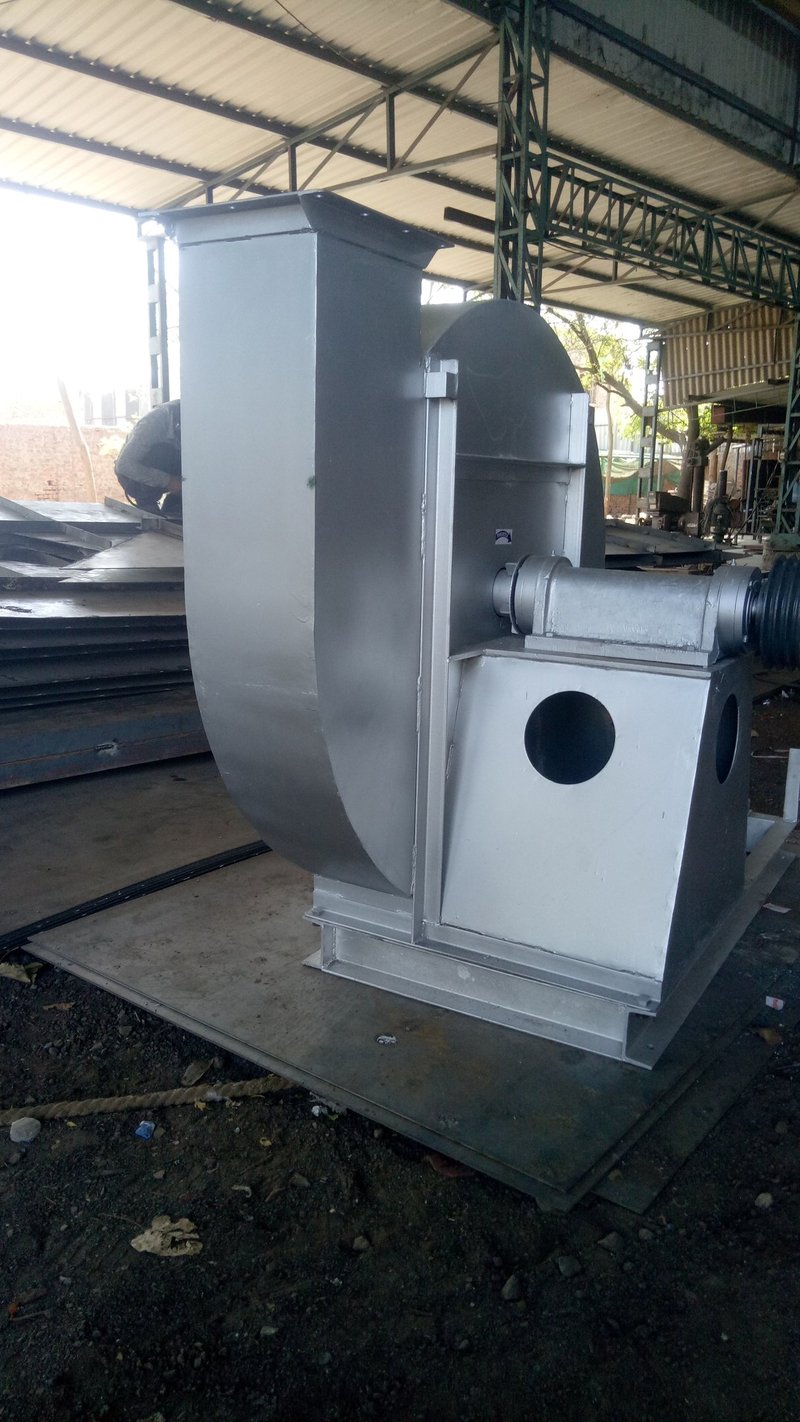
We have supplied air systems to 30+ ceramic manufacturers. Our tile dryer fan packages feature: High-temperature centrifugal fans rated 200°C continuous (handling dryer exhaust), oversized motors accounting for high-altitude derated power, and corrosion-resistant construction (ceramic dust is mildly alkaline causing steel corrosion). For a vitrified tile plant (22,000 sq.m/day), we provided complete dryer ventilation—4 circulation fans (65,000 m³/hr each at 120mmWC, 132 kW motors) achieving uniform drying with <3% moisture variation across tiles (critical for preventing warpage during firing). Our kiln combustion systems include precision VFD control with flue gas O2 measurement auto-adjusting air supply maintaining 2.5±0.3% O2 saving 9-14% natural gas (₹40-60 lakh/year for 25,000 Nm³/hr kiln) versus manual control. Payback <18 months. Our spray dryer installations feature explosion-protected fans (ceramic powder is combustible) and abrasion-resistant cyclones handling 200 kg/m³ dust loading collecting 85-90% powder for reuse.
Find answers to the most common questions asked by our clients.
Our team is here to help you find the perfect solution for your industrial needs.
Every facility is unique. Our engineers can design a system tailored to your specific Ceramic Companies requirements.
Need immediate assistance?
+91 9099199003Technical Assistant
Hello! I'm your Primeairtech technical assistant. I can help you with product specifications, industry solutions, and technical queries. How may I assist you today?